Description
Key Purposes & Benefits
-
Wrist Rotation (Pronation & Supination): To slide a disc onto a horizontal peg, the Child must rotate their wrist 90 degrees. This movement is essential for future self-care tasks like turning a doorknob, using a key, or scooping with a spoon.
-
Bilateral Coordination: This material encourages “two-handed” work. A toddler will often use one hand to steady the wooden base while the other hand performs the precise threading movement.
-
Crossing the Midline: As the Child reaches across the base to retrieve or place discs, they practice crossing the body’s midline, which is vital for brain development and coordinating the left and right hemispheres.
-
Spatial Depth Perception: Aligning a hole with a peg pointing sideways is more visually complex than a peg pointing up, as it requires the Child to judge distance and depth from a different perspective.
Structural Design
-
The Base: A sturdy wooden block that remains stationary.
-
The Dowel: A single, straight metal dowel fixed horizontally to the base.
-
The Disc: The disc is circular, as the round shape allows the Child to focus purely on the horizontal alignment without worrying about corners or edges.
How to Present the Material
-
Preparation: Place the material on a low table. Remove the disc and place it to the left of the base.
-
The Grip: Pick up the disc with your dominant hand.
-
The Rotation: Slowly and deliberately turn your wrist so the hole of the disc faces the tip of the horizontal dowel.
-
The Slide: Thread the disc onto the dowel and slide it all the way to the base.
-
Completion: To finish, show the Child how to slide it back off before inviting them to try.
The Horizontal Sequence
The horizontal dowel is the second stage in a three-part developmental sequence:
-
Vertical Dowel: Up-and-down movement (Mastery of the “drop”).
-
Horizontal Dowel (Straight): (This material) Mastery of wrist rotation and sideways movement.
-
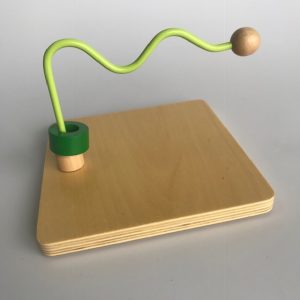
Curved/Serpentine Dowel: Mastery of complex, multi-directional movement (threading an object around a curve).
Why “Straight” before “Curved”?
The “Straight” variation isolates the challenge of rotation. Once the Child’s wrist is flexible enough to turn the disc 90 degrees and push it in a straight line, they are then ready for the Curved Dowel, which requires them to change their hand position multiple times to navigate a bend in the wood.
Size: 15cm x 15cm x 12cm (6″ x 6″ x 5″)
Further Reading and Resources:


Reviews
There are no reviews yet.