Description
Key Purposes & Benefits
-
Advanced Pincer Grip: To pick up and hold a flat coin, the Child must use a precise pincer grasp (thumb and index finger). This is one of the most direct early preparations for holding a pencil.
-
Wrist Control and Rotation: A ball can be dropped into a hole with a “loose” hand. A coin, however, must be perfectly aligned with the narrow slot. This requires the Child to rotate their wrist and stabilize their hand in mid-air; a significant motor milestone.
-
Object Permanence: Like the ball boxes, it reinforces the concept that the coin exists even when it is out of sight inside the box.
-
Goal-Directed Activity: The Child must perform a multi-step sequence: pick up the coin, align it, drop it, and then open the drawer to find it. This builds the neurological pathways for logical sequencing.
How it is Used
-
Grasping: The Child picks up a wooden coin from a small bowl or tray placed to the left.
-
The Slotting: The Child moves the coin to the top of the box. You will often see a toddler “testing” the slot, trying to push the coin in flat before realizing it must be turned vertically.
-
The Drop: Once aligned, the coin slides through with a satisfying clink.
-
The Retrieval: The Child pulls the knob of the drawer to reveal the coin(s) inside.
Why is the Coin Box harder than the Ball Box?
In the Montessori sequence, the Coin Box is considered more “advanced” for two main reasons:
-
Narrow Target: The slot is only slightly wider than the coin, leaving very little room for error compared to a round hole.
-
Dimensional Challenge: A ball is a sphere (symmetrical in all directions), while a coin is a thin disc. The Child must understand that the coin has a “thin side” and a “flat side” and only one of those sides fits into the slot.
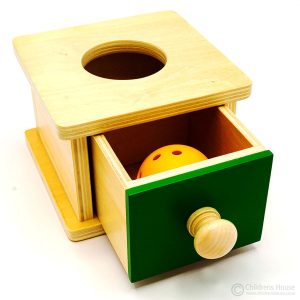
The Montessori Infant Coin Box is a traditional Montessori material for the Infant. The infant picks up the coin, inserts it into the slot, and ‘finds’ it again in the drawer. This is how they develop the crucial ‘pincer finger grip’, among other skills.
The ‘pincer finger grip’ develops the correct finger muscles to indirectly hold a pencil correctly, at a later stage of development. Additionally, this improves their hand-eye coordination, fine motor muscles and spatial awareness of their environment.
Control of Error
The “Control of Error” is entirely mechanical. If the coin is not turned the right way, it stays on top of the box. The Child receives immediate feedback and must adjust their wrist position or grip until the coin successfully “disappears.”
Pincer grasp development in the Coin Drop box
This video illustrates how the deliberate actions of dropping the coin and pulling the drawer help refine the pincer grasp and prepare the hand for more precise tasks like writing.
Contents, features and Dimensions of the Infant Coin Box
- Box – 12 cm x 12 cm x 9 cm / ( 5″ x 5″ x 3.5″ )
- Coin – 4.5 cm Ø x 0.5 cm / ( 2″ x ¼” )
- a quality box made from Birch ply
- contains 5 ‘coins’ made from sold Beech wood
- drawer slides in and out easily
Related Products
Further Reading and Resources
- The Global Montessori Network gives an example of a Coin Box Activity


ashleightayladk (verified owner) –
The perfect activity for my 12 month old. Purposeful and let’s the mind and hands work oh so perfectly together. My son has not stopped working with his coin box. A beautiful material to add to your environment! Thank you
Noleen Clarke –
My daughter of 15 months loves this game. It must remind her of peek-a- boo game. Excellent for hand and eye co- ordination.
Melanie Simms (verified owner) –
The shape and size of the coins are perfectly sized for the child at this young age. It really helps to strengthen their grip.
Delia Canteloube (verified owner) –
Our children enjoy working with this apparatus. Would recommend for anyone wanting to start a toddler class.