Description
Key Purposes & Benefits
-
Visual Discrimination of Size: The Child must look beyond the “roundness” of the piece and judge its area. They learn to distinguish between “big,” “middle-sized,” and “small.”
-
Mathematical Preparation: This is an early, concrete introduction to seriation (arranging objects in a series) and the decimal system (base-10 logic often found in Montessori materials).
-
Advanced Pincer Grip: The knobs remain the same size, but the weight and circumference of the circles vary, requiring the child to adjust their hand tension and control.
-
Spatial Reasoning: The Child must scan the board and match three different pieces to three different holes, increasing the complexity of the “search and find” process.
Structural Design
-
The Board: A rectangular wooden base with three circular cutouts.
-
The Pieces: Three circular insets that are identical in color and shape, but vary clearly in diameter (Large, Medium, and Small).
-
Isolation of Difficulty: By making all three circles the same color (blue), the material “isolates” the challenge of size. The Child cannot use color to cheat; they must rely entirely on their visual perception of dimension.
How to Present the Material
-
Preparation: Place the puzzle on the rug with all circles inside.
-
Removal: Using the pincer grip on the knobs, remove the circles one by one and place them in a scrambled row below the board.
-
The Matching Process:
-
Pick up the largest circle. Compare it to the holes.
-
Slowly place it into the largest cutout.
-
Repeat with the smallest circle.
-
Finish with the middle circle.
-
-
The Turn: Remove all pieces again and invite the Child to “find the home” for each circle.
Control of Error
The control of error is both physical and visual:
-
If the Child tries to put the large circle into the small hole, it simply won’t fit.
-
If the child puts the small circle into the large hole, it will fit, but there will be a significant gap around the edges. When they reach the final piece (the large circle), they will find it has no “home” left, forcing them to re-evaluate their previous choices.
The Developmental Path
This material is part of a series that grows with the Child:
-
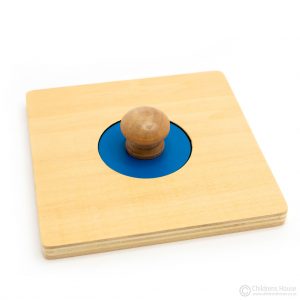
Single Circle Puzzle: Mastery of the shape.
-
Three Sizes of Circles: (This material) Mastery of dimension.
-
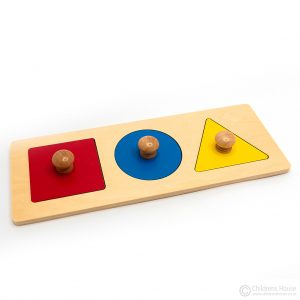
Three Primary Shapes: (Circle, Square, Triangle) Mastery of different geometric properties on one board.
Size of the Multiple Shape Puzzle – 3 Sizes of Circles
- Puzzle base – 32 x 12 x 1 cm / (12.5″ x 5″ x 0.5″)
- Large circle shape – 9 cm Ø / (3.5″)
- Medium circle shape – 7 cm Ø / (3″)
- Small circle shape – 5 cm Ø / (2″)
Related Products
- Multiple Shape Puzzle – Square Triangle Circle
- Single Shape Puzzle – Triangle
- Single Shape Puzzle – Large Circle
- Single Shape Puzzle – Square
Further Reading and Resources
Sensorial: Children at this age learn through senses more than through their intellect. The sensorial materials are tools for children to refine each of their senses. Each material isolates a specific quality: smell, size, weight, texture, flavour, colour, etc. In this preschool age, when children are “bombarded” with sensorial information, these materials allow them to find order and meaning to the world, raising his/her capacity of perception, favouring observation and a sense of admiration for everything that surrounds him/her.


Violet D (verified owner) –
The wooden puzzles are really good. Has lasted a long time in my classroom.