The Child believes that time is measured by actions, movement, how long (or short) it will be and it’s importance. “Time to wake up, to eat, sleep, to go to the park or to work.” Often, many parents/guardians say things like, “we will leave in 5 minutes.” This is meaningless to the young child. Rather, the care giver should provide a context of what must be completed prior to departure, i.e. “we will leave after you have fastened your shoes and I put the dog in the garden”. We have to be so careful to keep this fact, (that children cannot understand the abstract notion of time) in mind, when we teach the subject, Time. Begin by integrating concrete materials, for example the season timeline, when you present the 3-part cards that discuss time.
While young children may not easily grasp the abstract concept of time, they are nonetheless inundated with references to the measurement of time. They observe that understanding time, knowing what time it is, knowing how much time something is going to take, and the like, seem to be very important to the adults around them. The cultural structures of time are absorbed in the same way that children integrate other cultural norms.
The Early Childhood classroom includes some specific lessons to help children to make sense of those norms, to name qualities of time and to learn to “tell time,” a skill many children are motivated to learn as they model the values of the adults they love. While other activities may support children understanding of time, the Language lessons best support children’s ability to describe time as they learn to use those descriptions in their daily lives.
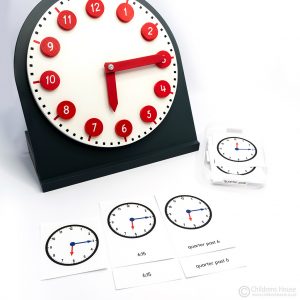
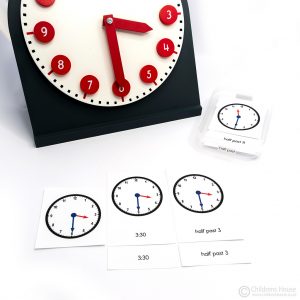
In many classrooms, you’ll find a simple, working analog clock with hands and numerals that allows the child to manipulate the parts of a clock as he or she learns the appropriate language (read more…)
“Clock Activity – Quarter Past” has been added to your basket. View basket